




EMDR Therapy in San Miguel de Allende
(Eye Movement Desensitization and Reprocessing)
Transform Trauma.
Restore Confidence.
Reclaim Your Life.
You’ve tried to move forward, but the weight of the past still sits in your body and mind. Anxiety, self-doubt, the echo of a difficult experience — these don’t just disappear with time. I can help you shift them at their roots.
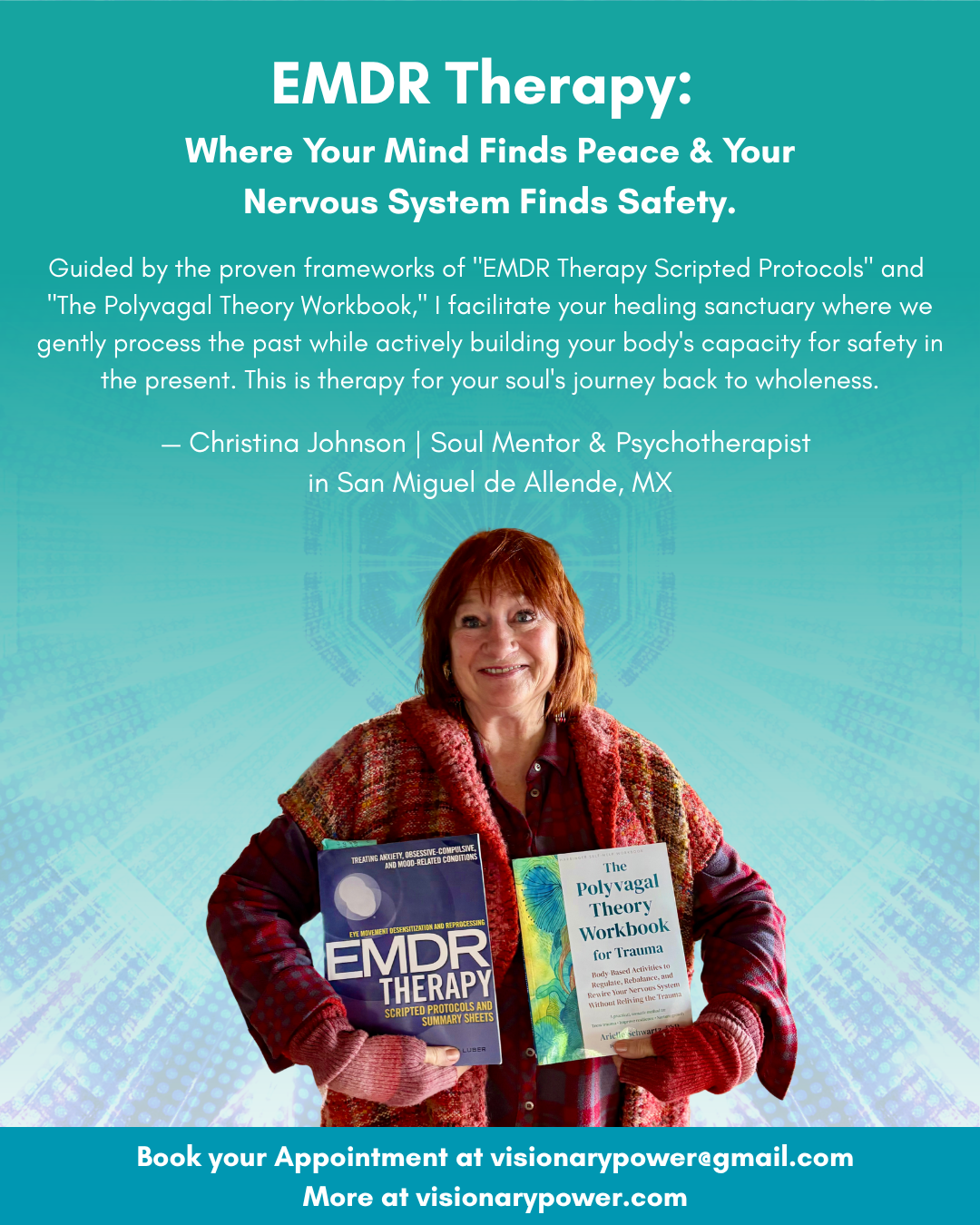
I’m Christina Johnson, LPC and I’ve been practicing EMDR since 1995 and have guided hundreds of people through this gentle, proven process. By staying current with annual conferences on EMDR, neurobiology and advanced trauma treatment I’lI make sure you receive care that’s both deeply experienced and informed by the latest understanding of how we heal.
Whether you’re carrying a single traumatic event, the cumulative load of a difficult past, or a performance block that’s holding you back, EMDR can help you finally feel free. I’d love to connect with you. Contact or email me with the button below and schedule a complimentary discovery call…
What is EMDR Therapy?
EMDR — Eye Movement Desensitization and Reprocessing — is an evidence-based therapy recognized by the World Health Organization, the American Psychiatric Association, and the U.S. Department of Veterans Affairs. Developed by Dr. Francine Shapiro, it allows people to process disturbing memories without needing to describe them in detail.
When a person is overwhelmed, the brain cannot file the moment in the usual way; the trauma stays open, like a door that will not close. The images, the sounds, the breath caught in the chest — none of it has aged. EMDR helps the door finally close — not by erasing what happened, but by letting the memory move from the loud room of the present into the quieter gallery of the past.
EMDR progresses quickly, with a goal in mind. My clients usually arrive with a present situation or past trauma that is damaging their lives. They may want resolution, peace, or a new path forward through forgiveness — a Holy Grail. Even those who are not yet aware of an objective can access the information the body holds through mindfulness and intention, and discover what the body and mind desire through somatic speech.
The body is a quiet teacher. The vagus nerve — that long, wandering messenger between gut and brain — needs gentle stimulation to shift us from fight-or-flight into connection and clear thinking. EMDR's bilateral movement, paired with breath and somatic awareness, helps the nervous system find its rhythm again. The body remembers safety the way rivers remember banks.
In session after session, I have watched a closed door open between the trauma and the rest of a person's life. We close the door to that old room, and step into the peaceful room of presence. Peace be still. Grief becomes bearable, panic becomes quiet, and self-blame loosens its long grip. The healing is not a miracle — it is the nervous system remembering its own intelligence.
How does EMDR work?
EMDR moves through eight distinct phases, each one designed to keep you safe and supported while we gently uncover and reprocess what’s been stuck. We go at the pace your nervous system can handle — never faster than feels right.
Phase 1 & 2: Getting to Know You, Getting Ready
We start with conversation. I’ll listen to what brings you in, what you’ve lived through, and where you’d like to go. Together we build a clear picture of your history and identify the memories that need attention. During this time, I’ll explain how EMDR works, answer every question you have, and make sure you have a handful of simple coping tools — grounding techniques, ways to settle yourself — before we touch any difficult material. Some people spend quite a bit of time here, and that’s perfectly fine. Feeling ready and safe is the foundation of everything that follows.
Phase 3: Setting Our Sights
Once we’re both clear on the direction, we choose a specific memory to work with. I’ll ask you to notice the image that comes up, the negative belief about yourself tied to it, the feelings it stirs, and where you sense those feelings in your body. We take a quick baseline measure so we can track your relief as it unfolds.
Phases 4, 5 & 6: The Heart of Reprocessing
These are the phases people most often associate with EMDR. While you hold the memory in mind, I’ll guide you through bilateral stimulation — side-to-side eye movements, gentle tapping, or alternating tones. This dual attention keeps one foot in the present while allowing the brain to digest the past. As the emotional charge subsides, we’ll gently shift to strengthening a positive belief you’d rather carry — something like “I am safe now” or “I handled it the best I could.” We’ll continue until that belief feels solid and true. Then I’ll ask you to scan your body from head to toe, holding both the memory and the new belief. Any lingering tension or unease gets its own gentle attention until your body feels clear and at rest.
NOTE: It is common for the original memory to be stored together in an associative network. A ‘‘major’’ trauma often sits at the center of a network linked to smaller or related experiences that share the same theme.
Phase 7: Closing with Care
Every session ends with closure, whether we’ve finished with a memory or are still in the middle of it. I’ll guide you back to a calm, present state, and we’ll make sure you feel steady before you walk out the door. I’ll also share what you might notice between sessions — a little fatigue, vivid dreams, emotions that rise and fall — all signs that your brain is continuing to integrate the work. After every session we will have optional homework to assist the integration.
Phase 8: Checking In
When you return for your next session, we’ll start by gently revisiting what we worked on before. We’ll check that the distress stayed low and the positive belief still feels strong. From there, we’ll decide together what’s next and where the healing is leading you.
Most people notice meaningful change within 6 to 12 sessions. And through every phase, you’ll have a steady partner in the process — someone who’s walked this path with hundreds of people before you.
What Can EMDR Help With?
While originally developed for Post-Traumatic Stress Disorder (PTSD), EMDR is now widely used to treat:
- Trauma & Complex-PTSD (childhood abuse, assault, accidents, loss)
- Anxiety, Panic Attacks, and Phobias
- Depression & Complicated Grief
- Performance Anxiety & Self-Esteem Issues – ideal for artists, athletes, dancers, golfers, and public speakers
- Addictions & Unwanted Habits
- Chronic Stress & Burnout
And because EMDR links memory, emotion, and body sensation, it also works beautifully to enhance performance in sports, dance, or any area where you want to move past internal blocks.
EMDR in the Wider World
You may have noticed EMDR in the news lately. When people speak openly about their healing, it cracks the door open for the rest of us. I've been doing this work since 1995, long before it made headlines, and I can tell you: what you're seeing in these public stories is the same gentle, powerful process I bring into my sessions every day.
Sandra Bullock recently described how EMDR helped her recover from PTSD and alopecia after a home invasion. Prince Harry let cameras film an actual session, showing how bilateral tapping helped him process decades of grief. Paris Jackson has spoken about using EMDR to move through deep-rooted trauma. Their experiences echo what I see in my own practice — people finally able to set down a weight they've carried for years.
What strikes me most about these stories isn't the fame. It's the relief. The sense of coming home to yourself. That's exactly what I aim for with every person who walks through my door in San Miguel de Allende — whether you're an expat untangling old wounds, a local resident navigating a life transition, or someone traveling here specifically to do this work.
You don't have to be in the public eye to deserve that kind of healing. You just have to be willing to take the first step. I'll meet you there with the same steady, experienced presence I've offered for nearly three decades.
Curious to see what an EMDR session actually looks like? Here are a few of the interviews mentioned above — you'll notice how calm and grounded the process can be.
Love from my clients
“After my husband unexpectedly passed away I was diagnosed with PTSD, and EMDR was recommended as a treatment. I was fortunate to find Christina to work with and she has been a Godsend.
I highly recommend her.”
—L.N, EMDR Therapy Recipient
Why Work with Christina Johnson for EMDR in San Miguel de Allende?
Deep Experience You Can Trust
I began my EMDR journey in 1995, training under the pioneers of this method. For nearly three decades, I’ve attended yearly conferences to integrate the latest neurobiological research and advanced techniques. You are in skilled, seasoned hands.
A Truly Holistic Approach
My background spans over 30 years in the healing arts. I combine EMDR with psychodynamic, cognitive-behavioral, and body-centered therapies. If it supports your healing, I may weave in other holistic modalities—always respecting your comfort and your soul’s purpose.
Based in San Miguel de Allende, Mexico
I’ve lived and practiced here since 2013, deeply understanding the expat and local community. My practice offers a safe, confidential space in the heart of this beautiful city.
No Need to Re-Live the Pain
EMDR with me is gentle. You won’t be pushed to describe graphic details. We work with what feels manageable, and we pace everything to your nervous system’s readiness.
Love from my clients
“I have been blessed to know Christina Johnson since 1999. Several times over the intervening years she has performed what must be miracles in aligning my skeleton to relieve the terrible pain of a jammed spine – instantly, with only one treatment session each time. She has aligned my jaw to correct a cross bite and re-established the nerve connections on the left side of my face when dental surgery complications caused pro-longed numbness and swelling that had gone on for more than six months.
Christina used EMDR to give me back my life when the crippling grief over my son’s death, in 2002, had me emotionally and physically paralyzed. There are not strong enough words of praise in our language to express my appreciation for Christina’s care and assistance in my life’s problems.”
—Kathy M., EMDR and Craniosacral Therapy Recipient
What to Expect in Your First Sessions
We’ll start with a free phone consultation to see if we’re a good fit.
In our initial face-to-face sessions, I’ll listen deeply to your story and your goals.
Together, we’ll identify the memories or patterns that are keeping you stuck. I’ll teach you grounding techniques so you feel safe and in control before we begin the bilateral stimulation.
Many of my clients tell me,
“I’ve been in therapy for years, but EMDR was what finally allowed me to move past it.”
That could be your story, too.
“For the traumatized person, images, sounds, smells and feelings haven’t changed when they are reminded of the trauma. EMDR allows those fragments to finally integrate and lose their power.”
— Christina Johnson, LPC and EMDR Therapist
Begin Your EMDR Therapy with me today…
You don’t have to carry this weight any longer. Take the first, gentle step.
Free Phone Consultation
Call +1 601 431 4724 or email visionarypower@gmail.com to schedule a relaxed, no-obligation conversation.
We’ll talk about what you’re looking for and how I can help.
Servicios en inglés y español disponibles.